
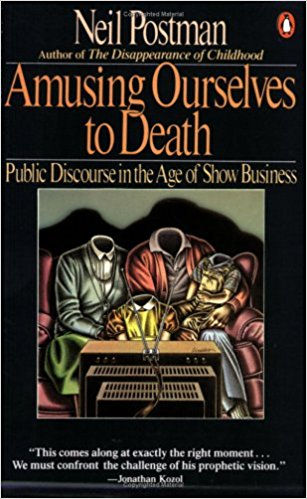
Book Review: Amusing Ourselves to Death by Neil Postman
- S.J.
- Jul 7, 2018
- 6 min read

If there was a man that could be dubbed a "secular prophet" this man would be that man. Through his own studies, research, and discerning wit, he came to a startlingly, and disturbing, revelation that would rock the modern world...if, of course, the modern world would concentrate long enough to listen.
For generations, parents have told their children "You're watching too much TV!" But Neil Postman is the man that eagerly informs readers as to why the parents were right. Penned in 1985, the revelations of this book are, sadly, even more true today. Today's culture of 5 second "Vines," simple "memes," and the median news story length being a paltry 41 seconds are all linked to the cultural shifts examined by Mr. Postman. (1)
The forward begins on a chilling note, referencing the well-known dystopian novel 1984 but then also comparing with the, if anything, even more unsettling Brave New World. (I have only read the latter, and don't recommend it, especially to minors.) The plots and settings of the two books are rapidly contrasted in a flurry of sentences that ends with these short lines: "In short, Orwell feared that what we hate will ruin us. Huxley feared what we love will ruin us. This book is about the possibility that Huxley, not Orwell, was right."
Today, however, we see that this statement was partially wrong.
It is not a possibility, it is now a certainty.
But, what does that ruin look like?
A study by Microsoft's Canadian division concluded that humans now have around an 8 second attention span. (2) That's less than the generally accepted 9 second attention span of a Goldfish. (3) However, statistics aside, any preacher, teacher, educator, and parent can tell you that kids are rather more distracted than they used to be "back in the day." Everything must be entertaining, or else the kids simply won't pay attention well. However, as much as they may not like to admit it, adults themselves are hardly better. Some say it's from a lack of discipline, and that's a big part of it. Others say technology, and that's the part addressed head on by Mr. Postman.
The book is divided into two major parts; creatively named "Part 1" and "Part 2."
The first begins with a look at mediums of communication, and the limitations and unique qualities of them. In chapter 1, he begins to lay the underlying premises that, as he calls it, "the medium is the metaphor." In other words, the way something is communicated greatly affects the content, perception, context, and meaning of the message. He offers examples of how different mediums have different limitations. Smoke signals, for example, are completely inadequate to convert any sort of philosophy, and pictures have a hard time showing more abstract concepts. (Pictures can show acts of love, or something about love, but cannot communicate the concept of love itself.) He concludes chapter 1 by saying that a cultures dominate form of communication will shape that culture. He then spends the remainder of Part 1 poking and prodding the merits and detriments of American culture when it was, at the first, dominated by the printing press, and then, how images and photography began the shift that video and TV would eventually vastly accelerate. Chapter 3 takes a good, long look at "topographical America" and how books, papers, and writings affected the culture.
Chapter 4 builds on that up to the next stair by looking at the advent of TV, and how this new medium swiftly began to take over, and change, the minds and hearts of America. Each medium affected the way those who encountered it thought, felt, and processed information, and that change was not, and is not, always for the better.
Part 2 contains the shift from looking at the past to now looking to the future. In no uncertain terms, Mr. Postmen deftly proves that TV is not a mere extension or adaptation of the medium of print, but rather, a brand new medium that is fundamentally hostile to the old medium. He defines television as a "medium" from it as a mere "technology." As such, he seems to have no real problem with it as a technology, but only as the culture altering "medium" that is has become. He also presents the printing press, as a medium, is used to convey words and ideas, while the television is, conversely, a medium founded on entertainment. The rest of Part 2 proves, beyond a doubt, the effects television, is having, and will continue to have, on our culture and mental and social abilities.
As his book continues, his brilliant and irrefutable arguments, creative examples, and many references to studies, programs, and other relevant works reveal him as far more than the usual alarmist or simple uneducated "TV-hater." (4) Yes, by the end of the book you certainly feel his disgust with the medium. Though he never outright calls for the destruction or severe limitation of TV, that idea does seem implied, and creeps closer to the surface the closer one gets to the end of the book. Some may dismiss him as an extremist, however, I feel that his "radical" response and sharp language are necessary to shake his readers (including myself!) from their (and our) apathetic stupor on the issue. The siren call of TV as a medium has pulled many to dangerous waters, and Mr. Postman's book is just what is needed to bring balance once again.
In short, this book is dangerous. It attacks the sacred cow of our entertainment, communication, and conversation. But it doesn't leave us without hope. In the end, he offers the same solution Huxley offered in Brave New World; the need for education, awareness, and a call back to less entertaining, more stimulating, mediums of communication and information exchange.
While Mr. Postman examines this issue from a secular standpoint, his conclusions and warnings take on a whole new depth and meaning when seen in light of a Christian worldview. Biblical literacy is on a sharp decline, (5) and too few who claim to be Christians display any significant familiarity with it. (6) Churches, by and large, have shifted to more entertaining styles of worship, and more media driven experiences to draw visitors in and keep members around. Some preachers have adopted the use of video, audio, and specialized presentations to keep interest and convey ideas. Senior Pastors and children's workers alike have struggled to maintain attention when students often deem reading the Bible, preaching, and singing as "boring" and "not exciting," only to skip the next week's service to go watch a movie or stay at home to play video games. With the whirlpool tug of entertainment growing ever stronger, more is at stake than mere mental prowess and intellectual ability. No, we are fighting an upward battle to draw people to a deeper relationship with Christ and to a deeper knowledge of his word; a battle that demands our attention, our focus, and our minds. What a pity if we reach Heaven's shores only to find that we foiled God's best for our lives by being to fascinated with light entertainment rather than the heavy weight of eternity.
I think it is healthy, yea, needful, to radically consider one's own habits according to the principles and philosophy found in this book. As parents raising children, as pastors leading churches, and as men and women of the faith, we have a duty to prayerfully examine our own priorities and habits. Yet, the threat today is even greater, as the internet, smartphones, Youtube, and our endless fascination with, and reliance on, the newest devices has created a culture so immersed in entertaining screens that the newest generation (Post-Millennials) has even been nick-named iGen. (7)
Whatever our response, or non response, this is a book that we all need to read, if only to understand why modern America is, in some ways, the way it is.
Notable Quotables:
Chapter 2, opening sentence: "It is my intention in this book to show that a great media-metaphor shift has taken place in America, with the result that the content of much of our public discourse has become dangerous nonsense."
Chapter 6, Page 90, when discussion why deep mental discussions do not work well on TV: "Thinking does not play well on television, a fact that television directors discovered long ago [....] it is, in a phrase, not a performing art [...] But television demands a performing art."
Final sentence, page 161: "For in the end, he [Huxley] was trying to tell us that what afflicted the people in Brave New World was not that they were laughing instead of thinking, but that they did not know what they were laughing about and why they had stopped thinking."
5/5
You buy a newer edition here on Amazon.
Footnotes:
(1) Wormald, Benjamin. “Video Length.” Pew Research Center's Journalism Project, 16 July 2012, www.journalism.org/2012/07/16/video-length/
(2) An archive of the study can be found here.
(3) Some studies have refuted that stat, however, I said "generally accepted" for a reason.
(4) While these are referenced both in the text, and collected in a bibliography, his citations in both are slightly incomplete, forcing readers to flip back and forth from their page to the bibliography to get all the citation information. An annoying, but ultimately inconsequential formatting choice.
(5) See the Barna Group study here.
(6) See Albert Mohler's article here.
(7) Twenge, Jean M. IGEN Why Today's Super-Connected Kids Are Growing up Less Rebellious, More Tolerant, Less Happy-and Completely Unprepared for Adulthood and (What This Means for the Rest of Us). Atria Books, 2017.


Comments